

There’s a feeling in Bali right now that many people in the investment and business community are struggling to describe.
Not panic.
Not anger.
More… uncertainty.
And uncertainty is dangerous for any market.
Over the past months, the Governor of Bali has reportedly sent two separate requests to BKPM regarding the removal or restriction of certain KBLI classifications. One discussion centered around KBLI 70209 — consultancy services.
Another involved several business sectors including vehicle rental activities and business areas connected to property and real estate operations, including KBLI 68111.
The reasoning, as publicly discussed, appears rooted in concerns over abuse. That some foreigners use consultancy businesses mainly as an easier pathway for visas. That some sectors have become overcrowded. That too many foreign-linked rental and property businesses are operating in Bali. And to be fair — there probably is some abuse.
But here is where the conversation becomes important. Because Bali is no longer a small isolated tourism island operating on assumptions, emotions, or social media narratives. Bali today is part of a national and global investment ecosystem. Decisions – or even rumors of decisions – carry enormous consequences.
The Problem With Governing Through Sentiment
One of the biggest concerns many businesses now have is not regulation itself. Most serious investors actually welcome stronger regulation.
We support compliance.
We support proper licensing.
We support taxation.
We support enforcement against abuse.
What businesses struggle with is when large structural decisions appear to happen without transparent data, measurable analysis, or a clear distinction between genuine abuse and legitimate operations. Because those are two very different things.
Take KBLI 70209. Yes, some individuals may misuse consultancy structures. But many consultancy companies in Bali are very real businesses employing Indonesians, paying taxes, supporting foreign direct investment, assisting with licensing, legal structuring, architecture, accounting, sustainability planning, hospitality operations, and market entry.
Our own company falls into this category.And there are many others like us. Some consultants may technically operate from Bali while servicing clients across Southeast Asia.
Their companies are registered in Bali. Their taxes are paid in Bali. Their staff are hired in Bali. Their spending happens in Bali. If that pathway becomes difficult or politically unstable, what happens?
Most will simply establish their companies in Jakarta instead. They may still physically live in Bali. But the tax base moves elsewhere. That is not protectionism. That is leakage.
Bali’s Real Economic Engine
One thing Bali sometimes forgets is that foreign investment is not only about buildings. It is about ecosystems.
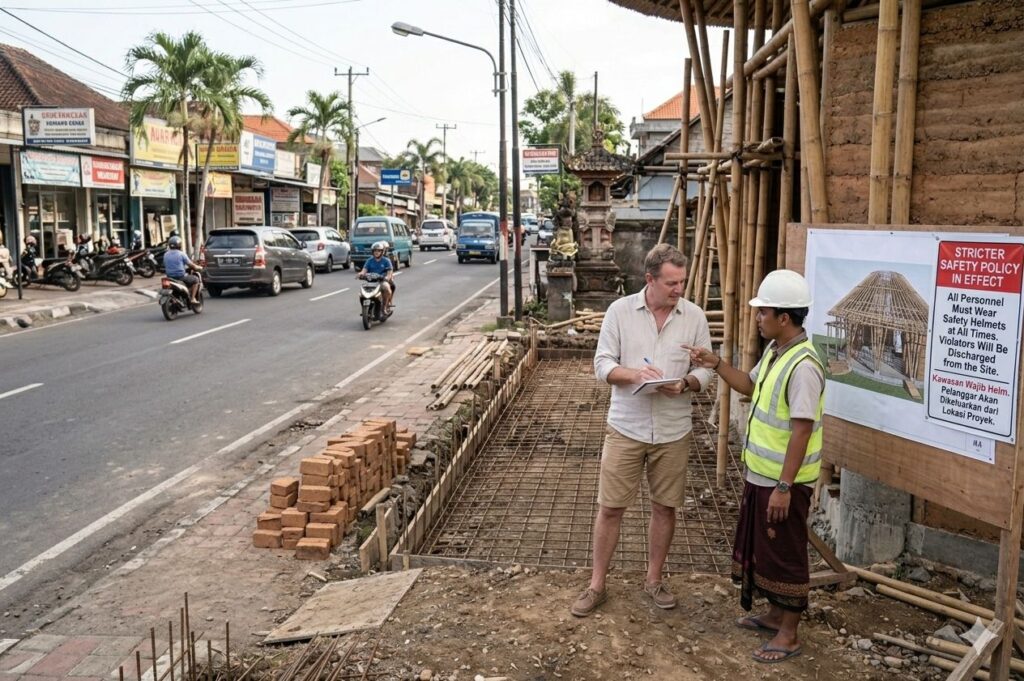
Behind every villa project are construction workers, architects, suppliers, legal teams, accountants, furniture makers, landscapers, cleaners, drivers, hospitality staff, maintenance teams, laundry services, restaurants, local warungs, and small family businesses.
A single investment project circulates through hundreds of livelihoods. And while there is absolutely a valid debate around overdevelopment, zoning pressure, infrastructure strain, and cultural preservation – those debates must still be balanced against economic realities.
If investment truly drops by 40% year-on-year, as some market estimates now suggest, the implications are massive. That could mean more than USD 1 billion in reduced capital movement.
Bali and even Indonesia as a whole cannot easily absorb that kind of slowdown without consequences. Especially not at a time when the government itself continues encouraging investment, downstream development, tourism growth, and international business participation.
The Dangerous Message Being Sent
The issue now is no longer only about regulations. It is about perception. And perception becomes reality in investment markets.
Right now, many foreigners are starting to feel that investing in Bali is becoming “almost impossible.” Whether that perception is fully accurate or not is almost secondary.
Markets react emotionally first. And when investors become nervous, projects pause. When projects pause, employment slows. When employment slows, thousands of Balinese families eventually feel the impact — from construction to hospitality.
This is the part that often gets lost in online debates. Because behind every discussion about “foreigners” are also local workers depending on economic circulation.
Enforcement Already Exists
The irony is that Indonesia actually already has the tools needed to address abuse properly.
The OSS system is becoming increasingly integrated.
Licensing systems are more data-driven than before.
Immigration systems are improving.
Tax reporting is improving.
Cross-agency coordination is improving.
If there are “bad eggs,” they can be identified. The solution does not necessarily need to be broad restrictions that create fear across entire sectors. Targeted enforcement is usually far healthier than creating uncertainty around legitimate industries.
The Question Around KBLI 68111
One of the more sensitive discussions involves KBLI 68111 and its relation to property ownership and real estate activity. And again, there are fair questions to ask.
Should foreigners directly operate every aspect themselves?
Should local participation be encouraged more strongly?
Should management structures involve Indonesian partners?
But these are solvable structural discussions. There are already models where asset ownership and operational management can be separated responsibly through partnerships with local operators and Indonesian management structures.
That conversation is far more productive than simply creating the impression that entire sectors are unwelcome.
Bali Must Remain Bali
At the core of this discussion is actually something emotional. Most people investing in Bali do not want to destroy Bali. Quite the opposite. Most came here because they fell in love with something unique: the culture, the spirituality, the warmth, the creativity, the ceremonies, the villages, the landscapes, the people.
And yes – Bali absolutely should protect itself. Bali should remain Balinese first. Its culture should never become secondary to tourism. But protecting Bali and rejecting investment are not the same thing. The real challenge is balance.
How does Bali slow irresponsible growth without collapsing confidence?
How does it regulate smarter without creating fear?
How does it protect culture while still creating jobs, opportunities, and prosperity for future generations?
A Better Way Forward
Maybe the answer is not less foreign investment. Maybe the answer is simply better structured investment.
Smarter zoning.
Better enforcement.
Clearer licensing pathways.
More transparent communication.
Data-driven governance instead of emotional reactions.
Because Bali’s future should not be decided through social media storms. It should be decided through long-term vision, intelligent systems, and constructive dialogue between government, local communities, and responsible investors.
Bali has always been strongest when openness and identity worked together. And perhaps that is the balance worth protecting most of all.