

Bali is at a crossroads. On one side, the island is experiencing an unprecedented wave of investment interest—villas, boutique resorts, co-living spaces, wellness retreats, and long-stay residential tourism.
On the other side, Bali’s zoning framework is undergoing the most significant regulatory transition in two decades, driven by the introduction of PP 28/2025, the shifting and digitization of RDTR maps, and the tightening of risk-based licensing.
The result? A perfect storm of confusion. Foreign investors are making decisions based on incomplete information, PMA companies are being set up incorrectly, consultants are giving contradictory advice, and notaries are registering businesses that legally cannot operate in the zones where they intend to build. Most investors don’t realize this until it’s too late.
This article breaks down why zoning is now the No. 1 factor determining whether an investment in Bali succeeds or collapses—and how today’s uncertainty can be navigated responsibly.
1. Bali Is Changing Faster Than Its Maps Can Keep Up
For years, Bali relied on older maps, customary practices, and mixed interpretations of regional rules. But now, under Indonesia’s shift to risk-based licensing, every investment must align with the RDTR (Regional Detailed Spatial Plan)— a digital, GIS-based zoning system that dictates what activities are allowed where.
The challenge?
- Some RDTRs are updated
- Some are still drafts
- Some conflict with earlier Perda regulations
- Some have not been harmonized nationally
Investors often assume that because an area looks developed, it must be legal to build a villa or operate a business. But zoning is not based on what exists physically — it is based on what the RDTR designates, even if that differs from current land use. This mismatch is causing major investment mistakes.
2. Misleading Advice From Consultants Is Making Things Worse
A major portion of today’s risk comes from inaccurate consulting. Many market players still tell investors:
- “You can build villas anywhere.”
- “A PMA makes everything legal.”
- “Nobody checks zoning.”
- “Airbnb is residential, so it’s fine.”
- “Everyone does it this way.”
This is extremely dangerous. Enforcement is increasing, not decreasing. With digital tools like OSS, PBG, SLF, and RDTR Online, authorities now have visibility into:
- Where properties are built
- What zoning applies
- What KBLI codes a PMA holds
- Whether the business activity matches the zoning
- Whether leases are registered
- Whether taxes are paid
The era of shortcuts is ending.
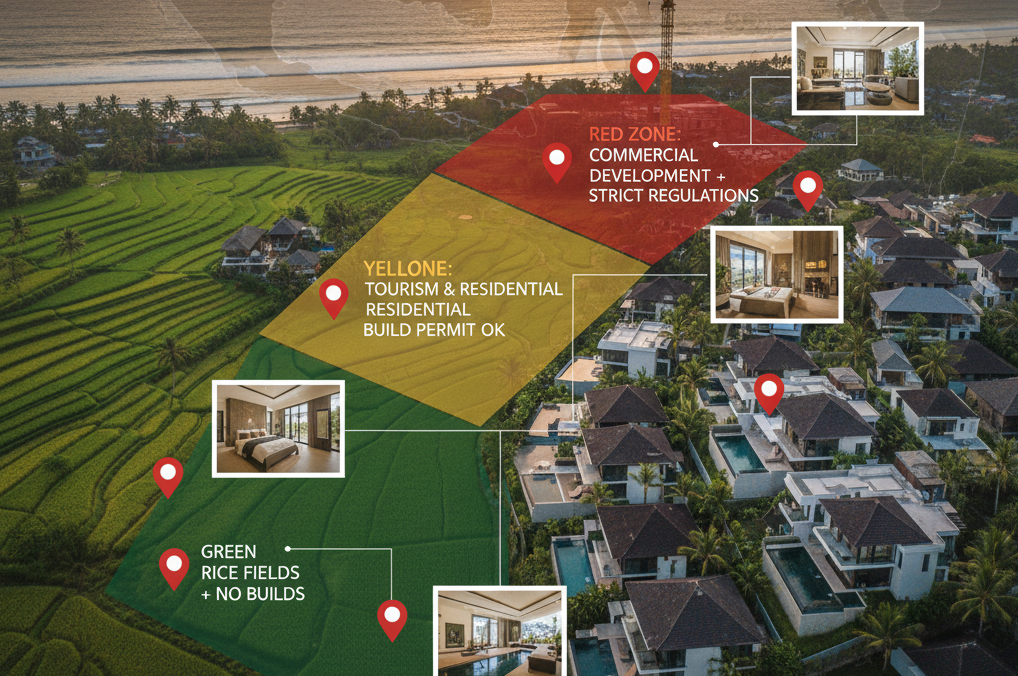
3. The Most Common Zoning Mistakes Foreign Investors Make
Here are the zoning errors we see repeatedly today:
a. Building Commercial Villas in Protected or Agricultural Zones
If RDTR lists the land as:
- Protected (LP)
- Agricultural (L3/L4)
- Green belt
- Cultural/heritage sub-zone
… a villa business is not permitted, regardless of what neighbors are doing.
b. Operating a PMA in a Zone Where Its KBLI Is Not Allowed
A PMA holding hospitality KBLI codes (55130, 55121, 5523xx) cannot legally operate in zones not designated for tourism or commercial use. A PMA is not a license to override zoning.
c. Assuming Hak Sewa (Lease Rights) Override Zoning
A lease does not override zoning. Even a properly registered Hak Sewa cannot legalize an activity that is not permitted by RDTR.
d. Believing a Building Is Legal Simply Because It Exists
A building is only legal if all the following align:
- Zoning
- PBG (building approval)
- SLF (operational feasibility certificate)
- PMA KBLI suitability
- Tax compliance
- Environmental classification
Many foreign-owned properties fail multiple criteria.
e. Running a Villa or Tourism Business in a Yellow Residential Zone (MOST COMMON TODAY)
This is the No. 1 mistake in Bali. The Yellow Zone (Residential Zone) is meant for housing, not tourism. A villa in a Yellow Zone may be used as:
- A private residence
- A long-term residential lease
- A PMA-owned asset (KBLI 68110) without hospitality operations
But the following are NOT permitted:
❌ Daily rentals
❌ Airbnb / Booking.com
❌ Short-term villa operations
❌ Retreat hosting
❌ A PMA running a tourist accommodation business there
Many consultants wrongly claim that a PMA with KBLI 68110 can operate villas in Yellow Zones — this is false under PP 28/2025, Permenparekraf 6/2025, and RDTR rules. As digital enforcement expands (OSS, PBG/SLF, RDTROnline), Yellow Zone misuse will become one of the highest-risk investment mistakes.
4. Enforcement Is Coming — And It Will Reshape the Market
Authorities now have clear mandates to:
- Enforce zoning
- Shut down illegal villa operations
- Cross-check PBG and SLF
- Match KBLI codes with zoning
- Register leases with BPN
- Penalize PMAs in the wrong zones
- Hold notaries and consultants accountable for misinformation
This aligns with the post-PP 28/2025 shift toward:
- Transparency
- Compliance
- Environmental protection
- Cultural respect
- Digital governance
Responsible investors will benefit. Shortcut-seekers will not.
5. A Responsible Investor Mindset Is Now Essential
To avoid problems, investors must:
1. Start with zoning BEFORE buying land
2. Check RDTR, KKPR, and environmental classification
3. Structure PMA KBLI codes correctly
4. Avoid consultants who promise “no problem”
5. Engage with the banjar and community early
6. Register leases properly with BPN
7. Ensure PBG and SLF are valid
Bali is not rejecting investment — it is requiring investment to be orderly, legal, and sustainable.
6. The Role of BTIC — Creating Clarity in a Confused Market
The Bali Tourism & Investment Chamber (BTIC) exists to bring clarity where confusion dominates. BTIC can help:
- Translate regulatory changes
- Provide verified information
- Facilitate investor–government communication
- Restore trust in the investment ecosystem
- Promote sustainable, compliant development
- Encourage enforcement against misinformation
As zoning continues to evolve, BTIC will play an increasingly important role in helping investors and government align.
Conclusion: Zoning Will Decide Bali’s Future
Zoning is not a technicality. It is the foundation of legal investment. If Bali gets zoning wrong, the island risks environmental damage, cultural erosion, and legal instability.
If Bali gets zoning right, it becomes one of the most sustainable, transparent, high-value investment destinations in the world.
One thing is certain: The time for shortcuts is over. Responsible, compliant investment is the only viable path forward.