

Foreign investors often hear that Indonesia’s rules on paid-up capital for foreign-owned companies (PT PMA) have “changed again” following the issuance of Government Regulation (PP) No. 28 of 2025.
In practice, however, much of the confusion comes from misunderstanding where PP 28/2025 actually sits within Indonesia’s regulatory framework.
This article clarifies what PP 28/2025 does (and does not do), how paid-up capital for PT PMA is regulated today, and how these rules are implemented operationally through SABH and OSS.
1. What PP 28 of 2025 Actually Regulates
PP 28 of 2025 governs Risk-Based Business Licensing (Perizinan Berusaha Berbasis Risiko – PBBR). Its focus is on:
- issuance of NIBs,
- Standard Certificates and Permits,
- verification and supervision mechanisms,
- administrative sanctions, suspension, and revocation of licenses.
What PP 28/2025 does not regulate is equally important:
- it does not set the amount of paid-up capital for PT PMA;
- it does not regulate how capital must be deposited;
- it does not replace investment or company law provisions.
Instead, PP 28/2025 assumes that capital and investment requirements are governed by lex specialis regulations, which are then declared and committed through the OSS system.
2. The Core Legal Framework for Paid-Up Capital in PT PMA
a. Company Law: Legal Entity Validity
Under the Limited Liability Company Law:
- a PT must have authorized capital;
- at least 25% must be subscribed and fully paid-up at establishment;
- payment must be supported by valid proof (cash or in-kind).
These rules apply to all PTs, including PT PMA.
Minister of Law and Human Rights Regulation No. 49 of 2025 operationalizes this by requiring:
- proof of capital deposit to be submitted through a notary,
- retention of such proof in the Legal Entity Administration System (SABH),
- paid-up capital to exist before the PT is legally approved.
Without this, a PT PMA simply cannot exist as a legal entity.
b. Investment Law: PMA-Specific Thresholds
For foreign-owned companies, Investment Ministerial Regulation (BKPM) No. 5 of 2025 adds additional layers.
There are two separate but parallel financial thresholds:
1️⃣ Minimum Investment Value
- More than IDR 10 billion, excluding land and buildings,
- calculated per KBLI per project location,
- with sector-specific variations and exceptions.
This figure relates to the overall investment plan: assets, capex, and working capital.
2️⃣ Minimum Issued / Paid-Up Capital
- IDR 2.5 billion per PT PMA,
- unless sector-specific regulations state otherwise.
This is the equity component that must actually be injected into the company.
These two figures serve different legal purposes — and are often incorrectly conflated.
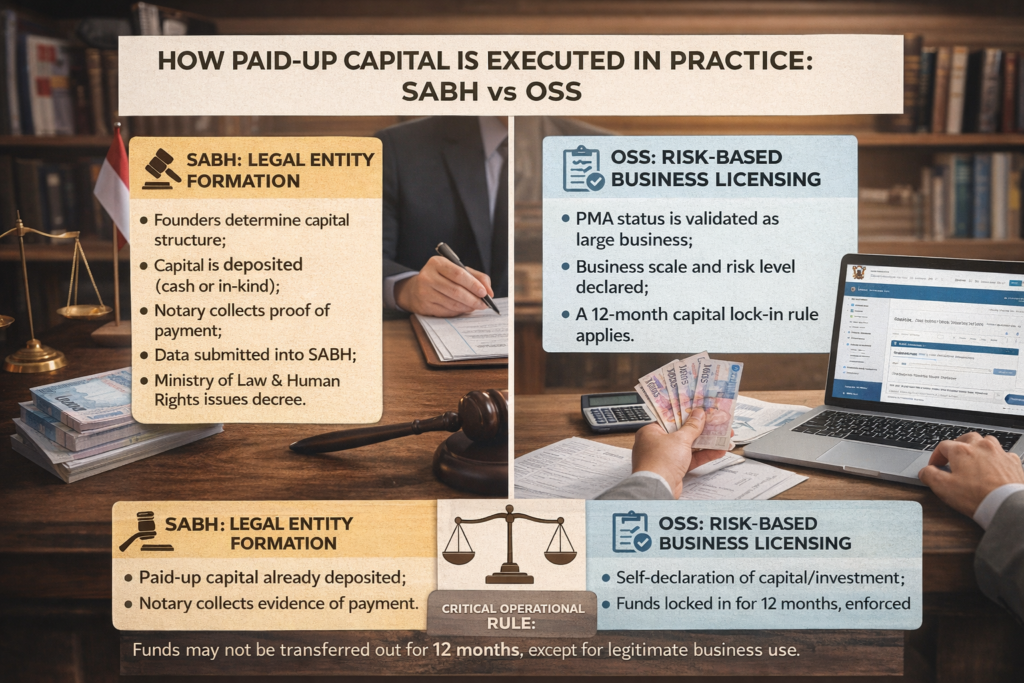
3. How Paid-Up Capital Is Executed in Practice: SABH vs OSS
a. SABH: Legal Entity Formation
At establishment stage:
- founders determine capital structure;
- capital is deposited (cash or in-kind);
- the notary collects proof of payment;
- data is submitted into SABH;
- the Ministry of Law and Human Rights issues the PT approval decree.
At this stage:
- paid-up capital must already exist;
- SABH does not “test” PMA thresholds, but it legally fixes the capital figures.
b. OSS: Risk-Based Business Licensing (PBBR)
OSS comes after the PT PMA already exists. In OSS:
- capital and investment values are declared, not re-paid;
- PMA status is validated as a large business;
- business scale and risk level are classified under PP 28/2025.
A critical operational rule applies here:
Paid-up capital for PT PMA may not be transferred out of the company’s account for 12 months, except for legitimate business use (assets, construction, operations).
This obligation is:
- made through a self-declaration in OSS,
- not proven by uploads at the initial stage,
- enforceable through administrative sanctions if violated.
4. How PP 28/2025, Paid-Up Capital, and OSS Fit Together
In simplified terms:
- Company Law + Permenkumham 49/2025
→ determine whether the PT legally exists with valid paid-up capital. - Investment Regulation 5/2025
→ determines how much capital and investment a PT PMA must commit and retain. - PP 28/2025
→ governs how licensing is issued, verified, supervised, frozen, or revoked.
OSS functions as the integration layer, not the rule-maker.
5. Practical Takeaway for Investors and Operators
A PT PMA will generally be treated as compliant if:
- the deed and SABH reflect:
- ≥ 25% paid-up capital,
- ≥ IDR 2.5 billion issued/paid-up capital;
- the OSS submission declares:
- investment value ≥ IDR 10 billion per KBLI/location (subject to sector rules);
- the business actor signs:
- the 12-month capital non-transfer declaration.
If these elements align, PP 28/2025 operates procedurally, not substantively — and the OSS licensing process should run smoothly unless post-licensing supervision uncovers inconsistencies.
How Seven Stones Indonesia Can Assist
Seven Stones Indonesia supports foreign investors throughout the entire PMA lifecycle, including:
- PT PMA structuring and capital planning,
- coordination with notaries and SABH submissions,
- OSS-based PBBR licensing and compliance,
- investment value modelling by KBLI and location,
- post-licensing supervision and risk mitigation.
Our focus is not only getting licenses issued, but ensuring that the capital, investment, and operational structure remain defensible during audits and inspections.