

Indonesia has quietly entered a new phase of its regulatory evolution — one that finally aligns the tourism sector with the modern governance frameworks defined under PP 28/2025.
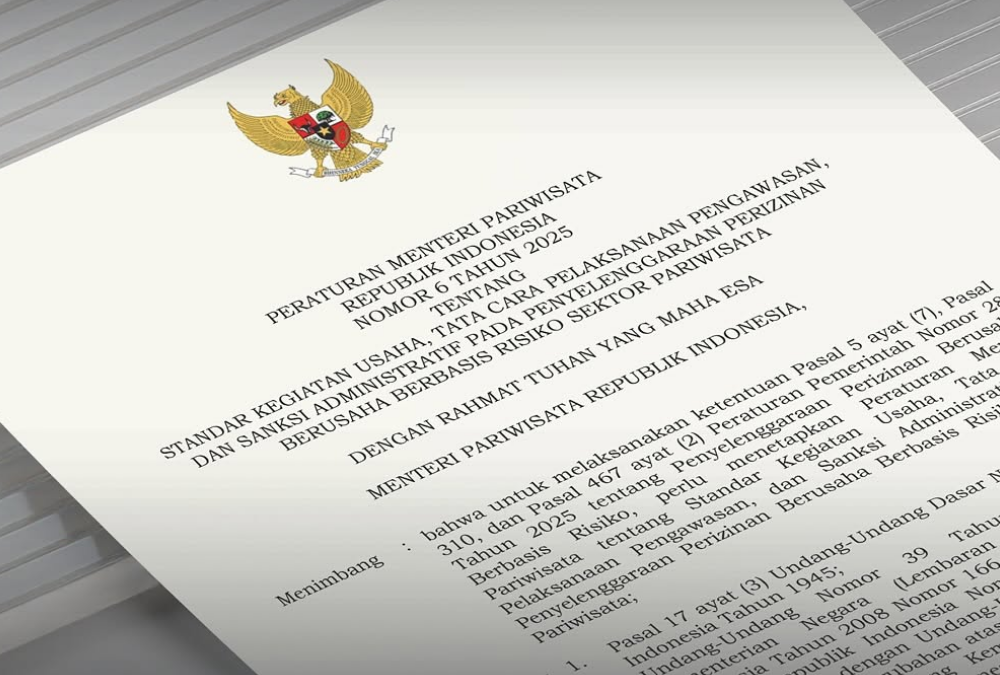
With the introduction of Regulation 6/2025, the Ministry of Tourism has signaled something much bigger than another bureaucratic update. It’s a structural shift designed to bring clarity, order, accountability, and national-level consistency to a sector that has grown rapidly but unevenly over the last decade.
For Bali, where tourism intersects with culture, land, communities, and sustainability every single day, this new framework matters deeply.
Why Regulation 6/2025 Is a Turning Point
The previous tourism standards — Regulation 4/2021 and Regulation 8/2021 — have now been repealed and replaced. In their place stands an expanded, much sharper framework:
▪ 61 KBLI tourism codes (up from only 12).
▪ Explicit risk-level classifications for every activity.
▪ Mandatory Tourism Certification for most operators.
▪ A unified, digital supervision system tied directly into OSS.
▪ Far clearer enforcement and sanctions.
For serious investors and operators, this is good news. It levels the field, pushes professionalism, and ultimately protects the long-term sustainability of Indonesia’s tourism ecosystem.
But it also means: everyone must adjust — and quickly.
One Year to Comply — or Face Sanctions
Any business actor (local or foreign) operating under the tourism KBLI categories must align with the new standards by October 2026 if their risk level has changed.
Existing OSS licenses remain valid, but operational standards must match the new regime.
This includes:
▪ Updating compliance procedures
▪ Ensuring all standards and obligations match the new risk level
▪ Securing the required Tourism Business Certification
▪ Preparing for both routine and incidental supervision
▪ Ensuring reporting and investment realization is accurate and timely
The era of “let’s wait and see” is over.
Supervision Will Be Tighter — and More Centralized
One major shift is supervision. For high-risk tourism businesses (including foreign-owned PT PMA companies) situated outside KEK or Free Trade zones, the Ministry of Tourism itself will supervise directly.
Supervisors — across central, provincial, and regional levels — now have the authority to:
- Conduct on-site inspections
- Request data
- Enter premises
- Take photos, videos, and samples
All this must be done without disrupting operations, but supervision will be active and continuous, not reactive.
For Bali, this is extremely relevant. A large portion of Bali’s tourism economy — accommodation, tour operators, wellness centers, recreational businesses, creative experiences — falls within these updated categories.
Sanctions Are Now Clearer, Simpler, and Faster
Regulation 6/2025 simplifies sanctions into three escalating categories:
- Reprimand
- Temporary Suspension
- License Revocation
Administrative fines have been removed, but the power to suspend or revoke a license has been made both sharper and faster to impose, especially if an operator endangers health, safety, the environment, or economic stability.
This is a very direct message: Tourism in Indonesia must be safe, compliant, and professionally run.
The Bigger Picture: Regulation as a Foundation for Sustainable Growth
When seen in isolation, Regulation 6/2025 may look purely technical.
But when placed inside the wider architecture — PP 28/2025, BKPM 5/2025, and the national shift toward risk-based licensing — it becomes part of a much larger transformation:
- Cleaner governance
- Stronger investor protection
- Better enforcement
- More data-driven oversight
- A more sustainable tourism model for Indonesia
For Bali, this transformation is long overdue. The island needs clarity. It needs enforcement. It needs standards that protect the culture, land, environment, and future of its communities. Regulation 6/2025 is not a silver bullet — but it is an important piece of the foundation.
Final Thoughts
Whether you operate a villa, resort, retreat center, restaurant, watersport business, or creative tourism enterprise, this new framework will affect you. But for operators who are serious about compliance, sustainability, and long-term value creation, this is an opportunity — not a threat.
Regulation 6/2025 is aligning Indonesia’s tourism sector with best practices globally. For those willing to adapt, it creates a safer, more predictable, and more professional playing field.
And for those who fail to adapt, October 2026 will come quickly.
If you need help understanding how the new standards apply to your specific operation, don’t hesitate to reach out. This is the time to get ahead — not the time to fall behind.