

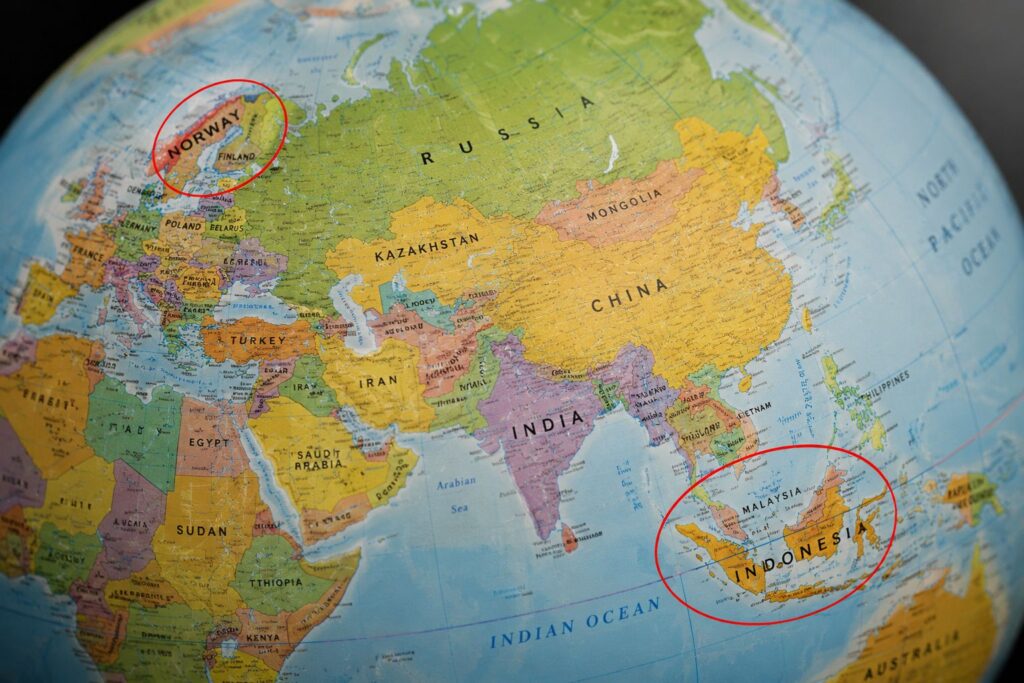
Two nations, two histories — and one surprisingly similar belief: that the economy should serve the people. There’s something fascinating about living between two worlds for long enough. You start noticing things others don’t.
As a Norwegian who has spent decades in Indonesia, I’ve often heard people describe the two countries as complete opposites. Norway is viewed as a highly organized Scandinavian welfare state.
Indonesia is seen as a fast-growing emerging economy navigating its own complex path. Different cultures. Different religions. Different climates. Different histories. And all of that is true.
But beneath the surface, there is actually a surprisingly similar constitutional philosophy running through both countries — especially when it comes to the role of the state, national resources, and the economy itself.
In many ways, both Norway and Indonesia believe something quite similar: That a nation’s wealth should ultimately benefit its people — not only private interests. And that the state has both a right and a responsibility to play an active role in shaping economic outcomes.
That may sound obvious to Indonesians. But it’s actually equally true in Norway.
The Indonesian Constitution: Strongly Nationalistic and Collective
Indonesia’s constitutional philosophy was born directly out of anti-colonial struggle. When Indonesia became independent, the founders had witnessed what happened when natural resources and economic systems were controlled externally.
The result was clear: political independence meant little without economic sovereignty. This became deeply embedded in Indonesia’s 1945 Constitution.
The most famous example is Article 33, which states: “The land, waters and natural resources contained therein shall be controlled by the State and exploited to the greatest benefit of the people.”
That is an incredibly powerful statement. It creates the philosophical foundation for:
▪ state-owned enterprises,
▪ resource nationalism,
▪ downstreaming policies,
▪ land regulation,
▪ and strong government involvement in strategic industries.
Indonesia’s founding fathers, especially Soekarno and Mohammad Hatta, were not advocating pure capitalism. They believed the economy should operate under what Indonesia often calls the “family principle” — asas kekeluargaan.
The idea was simple: the economy should function for collective prosperity, not merely individual accumulation. That mindset still influences Indonesia today more than many foreign investors initially realize.
Norway Quietly Built Something Similar
Now here’s the interesting part. Norway never used the same language constitutionally. But in practice, the country evolved into something surprisingly similar — especially after oil was discovered. When petroleum was found in the North Sea, Norway faced a choice.
Many countries had already shown what could go wrong:
foreign dominance,
resource extraction,
mass inequality,
and wealth disappearing overseas.
Norway chose another path. The state became heavily involved in:
▪ oil licensing,
▪ taxation,
▪ production,
▪ long-term management,
▪ and sovereign wealth accumulation.
The government built what later became one of the world’s largest sovereign wealth funds. Through Equinor (formerly Statoil), the Norwegian state maintained strong ownership and strategic control over energy resources.
The philosophy became: Norway’s oil belongs to the Norwegian people. Not just corporations. Not just shareholders. The people.
Sound familiar? In spirit, it is actually very close to Indonesia’s Article 33.
Neither Country Truly Believes in Pure Free Markets
This is where many people misunderstand both countries. Neither Norway nor Indonesia fundamentally believes that markets alone should dictate society. Both countries believe:
▪ the state has moral responsibilities,
▪ strategic sectors matter,
▪ inequality must be managed,
▪ and national resources require protection.
The difference is mostly how the systems developed and how effectively they were implemented. Norway built a highly institutionalized welfare state with:
▪ universal healthcare,
▪ strong labor protections,
▪ free education,
▪ and extensive redistribution.
Indonesia, meanwhile, focused more heavily on:
▪ nation-building,
▪ infrastructure,
▪ industrialization,
▪ food security,
▪ energy security,
▪ and strategic economic growth.
One became a mature welfare state. The other became a developmental state. But both share a similar constitutional DNA: the belief that the state should not be weak.
Indonesia May Actually Be More Explicit
Ironically, Indonesia’s constitution is arguably more openly collectivist economically than Norway’s. Norway’s social democratic system evolved gradually through political consensus, labor movements, and parliamentary tradition.
Indonesia placed many of these principles directly into the constitution itself. That surprises many foreigners. Especially those who assume Indonesia simply follows a free-market capitalist model.
In reality, Indonesia has always balanced private enterprise with strong state direction. And honestly, much of what Indonesia is doing today — downstreaming, resource control, industrial policy, digitalization of licensing systems, and strengthening national strategic sectors — fits perfectly within its constitutional philosophy.
The Real Challenge Is Balance
Of course, state involvement can become too heavy. Overregulation can slow growth. Bureaucracy can discourage investment. Protectionism can sometimes backfire. But pure uncontrolled capitalism creates its own problems too:
▪ inequality,
▪ speculation,
▪ foreign dependency,
▪ environmental destruction,
▪ and concentration of wealth.
The real art lies somewhere in the middle. And perhaps this is where Norway and Indonesia become most alike: both countries continue searching for that balance between markets and national interest.
Two Very Different Nations — With Surprisingly Similar Foundations
Living in Indonesia as a Norwegian, I’ve often found this comparison fascinating. On the surface, the countries seem worlds apart. Yet both societies fundamentally believe something quite similar: That a country’s natural wealth should not only enrich a few people. It should help build society itself. In Norway, that philosophy helped create one of the world’s strongest welfare systems.
In Indonesia, it continues shaping the country’s path toward becoming a stronger, more self-reliant economic power. Different roads. Different histories. But perhaps not such different ideas after all.